'Once the Hon'ble Supreme Court has declared the law, we are obliged to accept it. However, it is necessary to point out that the majority has not upheld the wisdom of the decision; nor has the majority concluded that the stated objectives were achieved,' the senior Congress leader said in a tweet.

Lack of decisiveness and courage to deal with PSBs may turn out be the biggest impediment to the Modi government's economic initiatives, says Debashis Basu.

The RBI has this year cut interest rates by 110 basis points in four instalments but banks have passed only a part of it to borrowers. Before the last reduction earlier this month of 35 basis points, the bank on an average had passed only 29 basis points out of 75 basis points cut affected during 2019.

Banks might hold on to lending rates for the time being.

Banks will need more funds, as they have to provide more capital.

The central bank can directly print money and finance the government, but it should avoid doing so unless there is absolutely no alternative, former RBI governor D Subbarao on Wednesday said while pointing out that India is 'nowhere' near such a scenario. In an interview with PTI, Subbarao suggested that to deal with the second wave of COVID-19 induced slowdown in the economy, the government can consider Covid bonds as an option to raise borrowing, not in addition to budgeted borrowing, but as a part of that.

Finance Minister Nirmala Sitharaman has said the recent interest rate hike by the Reserve Bank was not surprising for her but the timing was, asserting that the rising cost of funds will not impact the government's planned infrastructure investments. For the first time since August 2018, RBI had on May 4 delivered a blunt 40 basis points increase in key repo rate to 4.40 per cent, and also hiked the cash reserve ratio by 50 basis points to 4.5 per cent after an unscheduled meeting of the rate setting panel, citing increased inflation pressures following the Ukraine war and the resultant spike in crude oil prices. Retail inflation printed at 6.9 per cent in March and the April reading is forecast to top 7.7 per cent.

The year 2022 saw the Reserve Bank of India (RBI) start acting on the policy repo rate after a gap of two years. The six-member monetary policy committee of the RBI reduced interest rate sharply - by 115 bps - when Covid-19 struck in 2020. In March 2020, days after the nationwide lockdown was announced, MPC in an unscheduled meeting reduced the repo rate by 75 bps, followed by another 40 bps in May. Status quo was maintained for the next two years since the May repo rate hike.

Jaitley said the total gross NPA ratio has gone up to 4.03 per cent in 2013-14 from 3.42 per cent in 2012-13 and 2.94 per cent in 2011-12.

A strong appetite for gold on Friday's Dhanteras is expected this year due to auspicious reasons and geopolitical concerns, continuing the 2022 trend driven by pent-up COVID demand. Compared to last year's Dhanteras, gold prices have jumped 22 per cent and silver prices by 21 per cent, respectively. "Gold and silver are good for portfolio diversification, especially in times of geopolitical turbulence.

'Investment creates capacity and reduces inflation. Income, employment, and savings rise.'

'The rising cost of construction, the cost of doing business, high compliance, and inflation/interest rates going up have already reduced returns to single digits.'

Common use products like hair oil, soaps and toothpaste will be charged with a single national sales tax or GST of 18 per cent instead of present 22-24 per cent

The decision, the Reserve Bank of India said, "is expected to revolutionise the retail payments system of the country".

Let's wait for the monetary policy on February 8 -- to see how it complements the fiscal commitments, points out Tamal Bandyopadhyay.
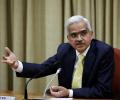
The government on Wednesday asked the Reserve Bank to maintain retail inflation at 4 per cent with a margin of 2 per cent on either side for another five-year period ending March 2026. To control the price rise, the government in 2016 gave a mandate to the RBI to keep the retail inflation at 4 per cent with a margin of 2 per cent on either side for a five-year period ending March 31, 2021.

The BJP had not filed till May the expenses statement for the Karnataka Assembly elections held last year in July.

'We have a plan to plough back a 'This year in the first half we had profits of more than Rs 31,000 crore.' significant amount of profits this financial year.' 'We have seen this organic plough back of profit is one of best ways to support the equity of the bank.'
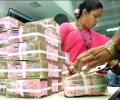
The Damodaran committee appointed by the Reserve Bank of India (RBI) to revisit the issue of banks' customer services is likely to recommend capping on service charges to small borrowers or vulnerable sections of society.

In his book, former governor Subbarao says Chidambaram, Pranab were piqued by his tight rate policy.

The size of the hole in today's banking crisis appears to be roughly 10 per cent of GDP.

As deputy governor, Patel headed the RBI panel to draft the monetary policy report, which became the basis of the ongoing reforms at the apex bank

Many bankers say the move will have a serious impact on the chain of command of nationalised banks and that it would only enable the government to dish out favours to a few of their own men.
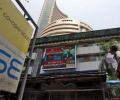
The stock markets, which had opened in the green on rate cut hopes, tumbled after the monetary policy announcement.

Mergers to create at most six state banks

Among the Sensex firms, Tata Motors jumped over 3 per cent. Tech Mahindra, Infosys, HCL Technologies, Axis Bank, Mahindra & Mahindra, ICICI Bank, UltraTech Cement and Kotak Mahindra Bank were the other major gainers. NTPC, Asian Paints, Titan and Power Grid were among the laggards.

'As an investor, I either have to exit my investments in the next three months or use dark pools or cash to transact. For a normal investor, it will be almost impossible to transact in bitcoin and other digital currencies.'
In policy review meet in June, RBI Governor Raghuram Rajan kept interest rates intact.

The Reserve Bank of India is in favour of a cautious and gradual approach to financial sector reforms rather than a big-bang approach, as advocated by the Percy Mistry Committee report on making Mumbai an international financial centre.
With retail inflation surprising on the upside, the six-member monetary policy committee (MPC) of the Reserve Bank of India (RBI) is expected to increase the repo rate by 35-50 basis points (bps) in the review scheduled for September 28-30. According to economists, the central bank will continue to focus on bringing inflation down even though economic growth has remained sluggish. Data released by the government on Monday showed that the consumer price index (CPI)-based inflation increased by 7 per cent year-on-year (YoY) in August, thus, staying above the upper tolerance limit of the central bank for all the eight months of 2022.
.jpg)
The government on Tuesday announced a host of measures to tame inflation, which had soared to a five-month high of 6.01 per cent in May.

The macro economic situation and currency depreciation might top the priority list of Reserve Bank of India (RBI) governor-designate Raghuram Rajan.

Officials said several witnesses were heard on the impact of the pandemic. They added that this was the longest meeting of the panel without a break so far.

The Reserve Bank on Thursday permitted banks to increase charges for cash and non-cash ATM transactions beyond free monthly permissible limit from next year. Bank customers will have to pay Rs 21 per transaction, instead of Rs 20, with effect from January 1, 2022, if they exceed the monthly limit of free transactions. "To compensate the banks for the higher interchange fee and given the general escalation in costs, they are allowed to increase the customer charges to Rs 21 per transaction. "This increase shall be effective from January 1, 2022," the RBI said in a circular.

Retail inflation fell to a five-month low of 4.35 per cent in September from 7.27 per cent in the year-ago period as prices of vegetables and other items declined, according to government data released on Tuesday. The moderation in Consumer Price Index-based inflation is in line with the assessment of Reserve Bank Governor Shaktikanta Das who recently projected substantial softening of retail inflation. The CPI inflation was at 5.3 per cent in August and at 7.27 per cent in September 2020.

The RBI governor, who made a presentation about the state of the economy as well about the world economy to the 31-member Parliamentary Standing Committee on Finance, stayed clear of controversial questions like government invoking special powers.
The move comes at a time when four foreign banks - Standard Chartered, Hongkong and Shanghai Banking Corporation, American Express and Citibank -- have moved the Supreme Court with a special leave petition and the hearing for admission of SPL is on September 8. The committee is, however, expected to wait till the Supreme Court decides on the issue before finalising its recommendations. The committee is, however, expected to wait till the Supreme Court decides on the issue.

After consumer price index jumped the 6.3-per cent mark in May and wholesale inflation set a record of 12.94 per cent, house economists at Swiss brokerage UBS Securities have warned that the country is facing more upside risks on the inflation front that is set to averaging at 5 per cent for the year. Rising prices of edible oils and protein rich items pushed retail inflation to a six-month high of 6.3 per cent in May, breaching the comfort level of the Reserve Bank and thus rendering reduction in interest rates a difficult proposition in the near term. Led by petrol price, that has crossed the Rs 100-mark in many states, wholesale inflation too accelerated to a record 12.94 per cent in May. While crude oil has crossed $70 a barrel on account of rising prices of crude oil and manufactured goods due to spike in commodities, and the low base of last year due to the lockdown.

In Chanda's defence, one can always say, why would the Videocon Group take care of her husband as a quid pro quo to get a loan? After all, the group has taken money from the entire banking industry and ICICI Bank's share in the pie is not even 10 per cent. So, if it had a quid pro quo with Chanda to get the money, it must have had similar arrangements with other banks, too. If this is not the case, one must accept that it had got money from all banks, including ICICI, without any under-the-table conditions, points out Tamal Bandyopadhyay.

RBi pushes for reinvigorating private investments, clearing infra bottlenecks and providing big thrust to Pradhan Mantri Awas Yojana.
 © 2026 Rediff.com - Advertise with us - Disclaimer - Privacy Policy - Sitemap - Feedback - About us - Terms of use - Grievances